Money out of thin air: Loans create deposits, M1 vs. M2
凭空造钱:贷款创造存款,以及 M1 与 M2 剪刀差
Before choosing a single stock, bond, or bank wealth-management product, you need one piece of plumbing that textbooks hide and bank brochures never explain: where money actually comes from.
在挑选任何一只股票、债券或银行理财之前,你必须先看懂一条教科书遮遮掩掩、银行宣传单绝口不提的底层管道:钱究竟是从哪里来的?
Most savers picture a commercial bank as a vault. You deposit ¥100 in cash, the bank locks ¥20 in reserve, and lends the other ¥80 to a homebuyer. That picture is backwards. In a modern credit economy, commercial banks do not lend out existing deposits — loans create deposits out of thin air.
绝大多数储户脑海里的商业银行,是一座保险库:你存进 100 元现金,银行锁起 20 元准备金,再把剩下的 80 元借给买房的人。这个直觉完全弄反了。在现代信用货币体系下,银行并不是拿已有存款去放贷,而是贷款凭空创造了存款。
When a bank approves a ¥10 million mortgage or an infrastructure loan to a local government platform, it does not haul banknotes out of a basement. A loan officer enters two matching lines on a digital ledger: +¥10 million Loan on the Asset side, and +¥10 million Deposit on the Liability side. In that single keystroke, ¥10 million of brand-new money enters the economy. When the loan is repaid, that money disappears back into nothing.
当银行批准一笔 1000 万元的房贷或地方城投基建贷款时,它并没有从地下金库里搬出一箱箱钞票。信贷员只是在电子账本两端同时敲下两行数字:资产端 +1000 万贷款,负债端 +1000 万存款。就在这一瞬间,1000 万崭新的货币凭空诞生并进入经济体;直到贷款被还清,这笔钱才重新湮灭。
To track what all that newly created money is actually doing, central banks sort it into three concentric buckets:
为了追踪这些凭空诞生的货币究竟在干什么,央行把货币划成三层同心圆:
- M0 (Cash in circulation) — physical banknotes and coins outside bank vaults. A tiny sliver of modern money.
- M1 (Active money) — cash plus corporate and liquid demand deposits ready to be spent right now. Think of M1 as the economy’s pulse and spending velocity.
- M2 (Broad money) — M1 plus time deposits, household savings, and money parked inside bank ledgers. Think of M2 as the total reservoir of financial claims, including “sleeping money.”
- M0(流通中现金)——银行体系之外的纸币与硬币,在现代经济中占比极小。
- M1(活钱)——现金加上企业与居民随时可支取的活期存款。可以把 M1 看作经济体的脉搏与花钱速度。
- M2(广义货币)——M1 加上定期存款、居民储蓄与停泊在银行账本里的资金池。可以把 M2 看作包含大量“沉睡资金”的总金融债权蓄水池。
This distinction solves China’s biggest macro puzzle of the past five years: how can M2 swell past ¥300 trillion while consumer inflation (CPI) hovers near zero? From 2021 through 2025, China’s annual CPI averaged roughly 0.7%, sliding to 0.23% in 2023, 0.22% in 2024, and just 0.06% in 2025 (dipping negative for much of the year), with 2026 YTD sitting near 0.88% mostly from oil-driven transport costs while housing (−0.3%) and food (−2.9%) stay deflated.
看懂这三层,过去五年中国最大的宏观谜题便迎刃而解:为什么 M2 一路飙破 300 万亿元,居民消费物价(CPI)却几乎趴在零轴不动? 2021 至 2025 年,中国年度 CPI 均值仅约 0.7%,2023 年滑落至 0.23%,2024 年为 0.22%,2025 年更是跌至 0.06%(年内多月同比为负);到了 2026 年前十个月均值也仅约 0.88%,且主要来自国际油价推高的交通成本,居住(-0.3%)与食品(-2.9%)仍处于通缩区间。
The answer is the M1–M2 scissors. Banks keep creating credit into M2, yet instead of flowing into household paychecks and retail spending (M1), newly created money pools inside time deposits, debt rollovers, and industrial supply chains. Money is being printed at the ledger level — and going straight to sleep.
答案就藏在 M1–M2 剪刀差 里。银行持续在账本端派生信用、推高 M2,但这些新造出的钱并没有流向居民工资与消费(M1),而是沉淀在定期存款、借新还旧与制造业供给扩张里。货币在账本上不断被造出来——然后原地沉睡。
Never judge an economy by M2 alone. Loans create M2 out of thin air, but only confidence turns M2 into M1 spending — and every ¥1 of M2 you hold has a real-world loan sitting behind it.永远不要只盯着 M2 的总量判断通胀与经济。贷款凭空创造了 M2,唯有信心才能把 M2 唤醒成 M1 消费——而且你手里的每一元 M2 存款背后,都对应着一笔真实世界的贷款资产。Trace a single bank balance-sheet expansion and compare Active Circulation against the 2023–26 Balance-Sheet Trap below to see how M2 swells even as M1 stalls.
在下方对照单张银行资产负债表的扩张过程,以及活跃循环与 2023–26 资产负债表陷阱的并排切片,直观看到 M2 如何在 M1 停滞时继续膨胀。
FIGURE 01 · ENDOGENOUS MONEY CREATION & THE M1–M2 SCISSORS
Loans create deposits out of thin air — confidence decides whether they wake up贷款凭空创造存款;决定它是否苏醒的是信心
- Central-Bank Reserves (unchanged)央行准备金(未动)¥60
- Property & Mortgages地产与按揭贷款¥140 +60
- LGFV & Infrastructure城投与基建贷款¥110 +40
- Industrial Credit工业制造信贷¥90
- M1 · Active Demand DepositsM1 活期与消费活钱¥120 +14
- M2 − M1 · Sleeping Time Deposits & WMPs定期存款与沉睡资金池¥280 +86
Bank issues +¥100 loan → 65% circulates into paychecks & retail spending (M1).银行新发 +¥100 贷款 → 65% 进入企业活期与工资消费(M1),货币流速畅通。
- M1 / M2 Ratio
- 37.0%
- +¥100 Split
- +¥65 M1 / +¥35 Time
- Property + LGFV Book
- 57% of loans
Bank issues +¥100 property/LGFV credit → 86% pools straight into sleeping time deposits (M2).银行新发 +¥100 地产/城投信贷 → 86% 直接沉淀进定期存款与借新还旧(M2),M1 停滞。
- M1 / M2 Ratio
- 26.8%
- +¥100 Split
- +¥14 M1 / +¥86 Time
- Property + LGFV Book
- 80% of loans
The asset conveyor belt: What banks hold and how “safe” gets sold
资产传送带:银行手里拿了什么,“稳健”如何卖给储户
Once you see that every ¥1 of deposit is simply the mirror image of a ¥1 bank asset, the obvious question follows: what are Chinese banks actually holding on the other side of your “safe” savings?
一旦明白每一元存款都只是银行账本上某一元贷款资产的镜像,下一个问题便直击要害:你手里“稳如泰山”的存款与理财,另一头究竟压着什么资产?
Look inside the balance sheet of China’s banking system and three massive pillars dominate:
掀开中国银行业的资产端,三大板块占据了绝对主力:
- Real estate & mortgages — residential home loans, developer credit, and corporate loans backed by property as collateral.
- Local Government Financing Vehicles (LGFVs / 城投) & infrastructure — loans and bonds financing roads, bridges, industrial parks, and municipal projects built after land-sale revenues (土地财政) began shrinking.
- State-backed industrial credit — manufacturing capacity financed at low rates, often competing inside razor-thin margins and overcapacity.
- 房地产与按揭贷款——居民房贷、房企开发贷,以及大量拿房产和土地作抵押的企业贷款。
- 地方城投平台(LGFV)与基建贷款——在土地财政收缩之后,继续支撑道路、桥梁、产业园与市政工程滚动的贷款与城投债。
- 国有与工业制造信贷——以低利率投向制造业产能的贷款,其中相当一部分正身处薄利与产能过剩的内卷之中。
Now watch the sell-side conveyor belt. Commercial banks, wealth-management subsidiaries, trust companies, and bond desks do not want to sit on all that long-term credit and duration risk forever. So the sell side packages those underlying assets — LGFV debt, bank perpetuals, corporate credit, and long-dated bonds — into clean retail wrappers labeled “R2 Low Risk,” “Fixed-Income+ (固收+),” “Steady Wealth Management (稳健理财),” or “Principal-Safe Bond Funds.”
接下来看卖方的资产传送带。商业银行、理财子公司、信托机构与固收卖方,并不想把全部长期信用与久期风险无限期留在自己表内。于是卖方把底层资产——城投债、银行永续债、企业信用债与超长期利率债——重新切片打包,贴上“R2 低风险”、“固收+”、“稳健银行理财”或“安心理财债基”的标签,摆上零售柜台。
The pitch is seductively simple: “Stocks swing 10% a day; take our steady 2%–3% yield and sleep well.” What the brochure leaves out is how the real economy still reaches straight into those “safe” products through three unavoidable channels:
销售话术极其动人:“股票一天跌 10%,不如买我们年化 2%–3% 的稳健产品,睡个安稳觉。” 宣传页绝不会告诉你,实体经济依然会通过三条避无可避的通道,直接击穿这些“安全”产品:
- Credit & collateral transmission: When home prices fall and local land sales dry up, the collateral backing mortgages and LGFV loans shrinks. Either credit stress surfaces directly inside WMPs, trusts, and credit bond funds, or borrowers must be bailed out and rolled forward.
- Financial repression (the hidden tax on cash): To keep trillions of unproductive debt from triggering a banking crisis, the central bank pins nominal yields near the floor — roughly 1.1% on bank deposits and 1.59% on 10-year Chinese Government Bonds (CGBs). Holding nominal rates below long-term nominal growth and external currency risk lets borrowers slowly roll their debts away at savers’ expense.
- Duration & rate shock: Even “risk-free” sovereign bonds are not free of market risk. Buy a 30-year CGB at a depressed yield, and a mere +100 bps shift in interest rates can inflict a 15%–20% mark-to-market loss overnight.
- 信用与抵押品传导:一旦房价下行、地方卖地收入枯竭,按揭与城投背后的抵押物价值同步缩水。风险要么直接爆在理财、信托与信用债基的净值里,要么只能靠系统性展期与兜底拖延。
- 金融抑制(对现金的隐形税):为了防止数以十万亿计的低效债务引发银行业危机,央行必须把名义利率死死按在地板上——一年期定存约 1.1%,10 年期国债收益率约 1.59%。把无风险名义利率长期压在名义增长与外部汇率风险之下,本质上是让高负债主体在储户的沉默补贴下慢慢滚债、消化包袱。
- 久期与利率反噬:哪怕是“零违约”的国债,也绝不等于没有价格风险。在极低利率区间买入 30 年期超长国债,只要收益率上行 +100 bps,账面净值就会瞬间回撤 15%–20%。
A 1.1% deposit or packaged bank WMP is not truly safe — it is pseudo-safe. It erases daily red-and-green flicker on your screen by locking you into financial repression, opaque credit exposure, and silent purchasing-power risk.1.1% 的定存和层层包装的银行理财并非真安全,而是伪安全。它抹平了手机屏幕上每天的红绿跳动,代价却是把你锁进金融抑制、不透明信用风险与静默的购买力缩水之中。The X-ray matrix below strips four everyday onshore “safe” products down to their underlying backing and compares how each holds up under Property & LGFV Drag and a +100 bps Rate Repricing Shock.
下方的 X 光矩阵把四类常见境内“稳健”产品拆到底层资产结构,并排对照它们在地产与城投拖累与 +100 bps 利率重定价冲击下的真实表现。
FIGURE 02 · THE SELL-SIDE CONVEYOR BELT X-RAY
Four onshore “safe” products stripped to their underlying backing & shock impact四类常见境内“稳健”产品 X 光透视:底层资产与两类宏观冲击对照
1Y Bank Time Deposit一年期银行定期存款
“100% principal-safe, zero daily volatility.” “100% 保本保息,零波动最安心。”
Banks cut deposit rates further to protect net interest margins while rolling over bad property/LGFV debt.为稳住银行净息差、帮地产与城投展期续命,存款挂牌利率一降再降,储户隐形买单。
R2 Bank Wealth Management (理财)R2 级银行稳健理财
“Low-risk R2 steady yield, smoother than stocks.” “R2 中低风险稳健增利,波动远低于股市。”
LGFV credit spreads widen and weaker regions restructure — triggering redemption waves like late 2022.弱区域城投利差走阔与信用重估引发赎回踩踏(类似 2022 年末理财破净潮),“稳健”瞬间变脸。
Credit / LGFV Bond Fund (城投债基)信用债 / 城投债基金
“Steady 3%+ fixed income backed by municipal infrastructure.” “市政基建背书,稳拿 3% 以上票息收益。”
Falling land-sale revenue forces debt extensions or coupon haircuts; secondary-market bids vanish.土地出让金萎缩迫使部分平台展期降息,二级市场流动性瞬间冻结。
30-Year Chinese Gov Bond (超长国债)30 年期超长期国债
“Zero sovereign default risk — the safest bond in the country.” “国家主权信用零违约,境内最安全的债券。”
A +100 bps reflation jump wipes out ~18% in mark-to-market price — stock-like drawdown on a “safe” bond!一旦财政刺激推动利率上行 +100 bps,长债净值暴跌近 18%——“无风险债券”瞬间跌出股票级回撤!
What to buy instead: State- and market-aligned A-share picks
那到底该买什么?顺应政策与全球市场的 A 股标的清单
You do not need an economics degree to stop settling for 1.1% bank deposits. Once you see why the system pins deposit rates near zero, the practical question is simple: if you only have a regular onshore RMB brokerage account, what is actually worth buying?
你完全不需要金融学或经济学学位,就能跳出 1.1% 定期存款的陷阱。看清系统为何把存款利率压在地板上之后,最实在的问题只有一个:如果手里只有一个普通的境内 A 股证券账户,现在究竟有什么值得直接买入?
Start with one reality of China’s 2026 economy: “Chinese stocks” is not one trade. Domestic housing and food prices remain weak, 10-year CGB yields sit near 1.59%, and foreign investors stay cautious under a 4.86% US Treasury yield and 20%–40% tariff threats. Yet at the exact same time, China’s exports surged +35.2% YoY (pushing the trade surplus past $1 trillion), industrial profits grew +16.0% YoY, and in November 2026 the PBoC rewrote the onshore floor.
先看清 2026 年中国经济的一条分水岭:“买中国股票”从来不是同一笔交易。 一边是国内居住与食品价格偏弱、10 年期国债锚定在 1.59%,外资面对 4.86% 美债与 20%–40% 关税威胁观望不前;另一边则是中国出口同比大增 +35.2%(年内顺差突破 1 万亿美元)、工业企业利润回升 +16.0%,而且 2026 年 11 月央行亲手改写了 A 股底盘。
Rather than re-inflating real estate, the central bank cut its Stock Buyback and Holding-Increase Relending Rate to 1.0% (roughly 1.6% all-in to borrowers), made it a permanent institutional facility (常设工具), and saw the four largest state banks commit over ¥600 billion in buyback credit within three weeks. In plain language: imagine the central bank walking up to the owner of the only toll bridge in town — whose tolls pay 3.5%–4.5% a year — and offering an endlessly renewable 1.6% loan strictly to buy back their own bridge shares whenever they dip. Local and central finances lost Land Finance (土地财政); under the New Nine Articles (新“国九条”), they are building Equity Dividend Finance (股权财政) to replace housing as the domestic savings floor.
政策层既不想再吹地产泡沫,也没打算大水漫灌,而是把股票回购增持再贷款利率下调至 1.0%(企业综合成本约 1.6%),正式转为常设制度工具,四大行三周内即承诺超 6000 亿元额度。说句大白话:想象央行走到城里唯一一座收费大桥老板面前——这座桥每年稳收 3.5%–4.5% 过桥费——递上一笔成本仅 1.6%、可无限续期的贷款,专门用来在桥股下跌时回购自家股票。失去了土地财政之后,政策正借新“国九条”刻意打造股权财政,把境内储蓄的安全底盘从银行存款搬到实体红利资产之上。
That gives an everyday A-share investor a straightforward menu of four state- and market-aligned building blocks — while deliberately skipping yield traps like Big-4 banks (opaque LGFV/property command risk) and luxury spirits (tied to property wealth):
普通 A 股投资者不需要死记复杂模型,直接看懂以下四类顺应政策与全球现金流的具体标的即可(同时主动避开背负隐性城投/地产黑箱的国有大行,以及强绑定地产财富效应的高端白酒):
- State-aligned physical cash cows (your new “deposit replacement”) — Anchor with 600900.SH China Yangtze Power (长江电力) (six cascade dams on the Yangtze paying ~3.15% forward yield, zero loan-book black box, zero tariff sensitivity) and 510880.SH SSE Dividend ETF (红利 ETF) (~4.20% cash yield directly backed by the 1.0% PBoC buyback spread, ~¥343/lot). To avoid single-stock concentration, strong onshore tollbooth peers include 601088.SH China Shenhua (中国神华) (integrated coal, dedicated rail, and ports), 600938.SH CNOOC (中国海油) (low-cost offshore oil/gas with a built-in USD-energy hedge), 600941.SH China Mobile (中国移动) (net-cash telecom monopoly), 003816.SZ CGN Power (中国广核) / 600886.SH SDIC Power (国投电力) (nuclear & Yalong hydro), and transport tollbooths like 600377.SH Jiangsu Expressway (宁沪高速) and 601006.SH Daqin Railway (大秦铁路).
- Market-aligned global winners (earnings independent of domestic property) — Start with 600660.SH Fuyao Glass (福耀玻璃) (~35%+ global auto-glass share with onshore US factories) and 601899.SH Zijin Mining (紫金矿业) (~9.6x P/E, ~3.66% yield, USD-linked copper and gold reserves). Beyond those two, China’s deepest tariff-resilient global roster includes localized overseas manufacturers 000333.SZ Midea Group (美的集团) and 600690.SH Haier Smart Home (海尔智家) (GE Appliances in the US), global EV/battery leaders 300750.SZ CATL (宁德时代) and 002594.SZ BYD (比亚迪) (building plants in Europe, Southeast Asia, and Latin America), global grid-equipment winners 002028.SZ Sieyuan Electric (思源电气) and 600406.SH NARI Tech (国电南瑞), med-tech exporter 300760.SZ Mindray Medical (迈瑞医疗), and hard-resource peer 603993.SH CMOC Group (洛阳钼业).
- Zero-premium real-asset protection (your currency & trade shield) — 518880.SH Huaan Gold ETF (华安黄金 ETF) (tracks Shanghai Gold Exchange Au99.99 with T+0 liquidity and ~0% premium, automatically capturing both global USD gold and any RMB depreciation), plus 159985.SZ Soybean Meal Futures ETF (华夏豆粕 ETF) and 159980.SZ Non-Ferrous Futures ETF (大成有色 ETF) (~¥210/lot), or 600547.SH Shandong Gold (山东黄金) for higher-beta equity leverage to bullion.
- Policy-backed domestic tech (a small, capped growth slice) — 002371.SZ NAURA Tech (北方华创) and 688041.SH Hygon Info (海光信息) (or 588000.SH STAR 50 ETF at ~¥124/lot to bypass the ¥500k STAR gate), joined by domestic-substitution peers 688012.SH AMEC (中微公司) (etching) and 688981.SH SMIC (中芯国际) (foundry) whenever US export bans tighten. Pair them on the global AI capex / trade-thaw side with 300308.SZ Zhongji Innolight (中际旭创), optical peer 300502.SZ Eoptolink (新易盛), or Main-Board-accessible AI hardware plays 002463.SZ WUS Printed Circuit (沪电股份) and 601138.SH Foxconn Industrial Internet (工业富联).
- 政策托底的物理现金奶牛(直接替代 1.1% 存款)——以 600900.SH 长江电力(长江六座梯级水电站,远期股息约 3.15%,无坏账黑箱、不受关税冲击)与 510880.SH 红利 ETF(约 4.20% 现金股息率直接受益于央行 1.0% 回购利差,一手仅约 ¥343)为核心锚;为避免单一水电仓位过重,同类别强力替代还包括 601088.SH 中国神华(煤电运港一体化)、600938.SH 中国海油(低成本海上油气兼美元能源对冲)、600941.SH 中国移动(净现金通信垄断)、003816.SZ 中国广核 / 600886.SH 国投电力(核电与雅砻江水电),以及 600377.SH 宁沪高速、601006.SH 大秦铁路等物理交通收费站。
- 赚全球钱的出海龙头(不靠国内房地产吃饭)——核心代表为 600660.SH 福耀玻璃(全球汽车玻璃市占超 35% 且在美本土建厂)与 601899.SH 紫金矿业(约 9.6 倍 PE、约 3.66% 股息,美元计价铜金储量);在此之外,更具纵深的抗关税出海阵营还包括 000333.SZ 美的集团与 600690.SH 海尔智家(欧美本土工厂绕开关税且派息回购扎实)、在海外加速建厂的新能源双雄 300750.SZ 宁德时代与 002594.SZ 比亚迪、受益于全球 AI 电网扩容的 002028.SZ 思源电气 / 600406.SH 国电南瑞、医疗出海龙头 300760.SZ 迈瑞医疗,以及铜钴硬资源同伴 603993.SH 洛阳钼业。
- 零溢价实物与汇率护盾(防汇率与贸易冲击)——518880.SH 华安黄金 ETF(锚定上金所 Au99.99 现货,T+0 交易且几乎零溢价,在纯人民币账户内自动同时计入国际金价与汇率波动),辅以 159985.SZ 华夏豆粕 ETF(农业关税反制对冲)与 159980.SZ 大成有色 ETF(上期所实物金属期货篮子,一手约 ¥210);若希望在现货黄金之外增加金矿经营弹性,可搭配 600547.SH 山东黄金。
- 政策刚性采购的国产硬科技(小仓位弹性筹码)——002371.SZ 北方华创与 688041.SH 海光信息(无 50 万科创板门槛可直接买约 ¥124 一手的 588000.SH 科创 50 ETF),同翼可补强国产刻蚀龙头 688012.SH 中微公司与代工咽喉 688981.SH 中芯国际;若想平衡贸易缓和与全球 AI 扩张,可小仓搭配 300308.SZ 中际旭创、光模块同伴 300502.SZ 新易盛,或无创业板/科创板门槛的主板算力硬件 002463.SZ 沪电股份与 601138.SH 工业富联。
Compare China’s 2021–2026 inflation path, the onshore yield ladder, and the PBoC 1.0% Toll-Bridge Buyback Spread below to see why the policy floor moved from bank deposits to physical dividend equities.
在下方并排对照 2021–2026 年中国 CPI 轨迹、境内收益率阶梯与央行 1.0% 收费桥回购利差,看清政策托底为何从银行存款转移到了物理红利资产。
FIGURE 03 · 2026 SPLIT MACRO & THE PERMANENT POLICY FLOOR
Near-zero CPI pinned yields to the floor — then the PBoC built a 1.0% buyback floor beneath dividend equities贴零 CPI 把存款与国债压在地板上;央行 1.0% 常设回购再贷款则把托底搬到了物理红利资产脚下
China Annual CPI (2021–2026*)
中国年度 CPI 走势- 2021Post-COVID supply normalization; low pork prices offset energy spikes.疫后供应链正常化,低猪价对冲了能源上涨。
- 2022Global commodity shock and lockdown logistics bottlenecks (peaked at 2.8% in Sept).全球大宗冲击叠加物流瓶颈(9 月见顶 2.8%)。
- 2023Property balance-sheet contraction and weak post-reopening household demand.地产资产负债表收缩,居民端需求偏弱。
- 2024Persistent deflationary drag from real estate and industrial overcapacity.地产拖累延续,制造业产能过剩压低商品价格。
- 2025Near-flat headline CPI; dipped into negative YoY prints (-0.1% to -0.7%) for much of the year.全年 CPI 几近归零,多月同比落入负区间(-0.1% 至 -0.7%)。
- 2026*Jan–Oct YTD average (0.70% YoY in Oct); cost-push transport inflation while housing (-0.3%) and food (-2.9%) stay deflated.1–10 月均值(10 月同比 0.70%);油价推高交通成本,但居住(-0.3%)与食品(-2.9%)仍在通缩。
Onshore Yield Ladder (Nov 2026)
境内收益率阶梯对照Permanent facility cut to 1.0% in Nov 2026 (~1.6% all-in to borrowers). 2026 年 11 月降至 1.0% 并转为常设工具(综合成本约 1.6%)。
Nominal stability via financial repression; subsidizes system debt rollover. 以名义平稳换取金融抑制,实质上补贴高负债主体滚债。
Pinned near historic lows while LPR stays flat (3.0% / 3.5%). 在 LPR 连续 18 个月按兵不动期间被锚定在历史低位。
Hydro monopoly cash flow; 0% personal dividend tax when held >1 year. 六座梯级水电垄断现金流;持股满 1 年免征股息个税。
+260 bps above 10Y CGB and +320 bps above PBoC relending base. 较 10 年国债高约 260 bps,较央行再贷款基准高 320 bps。
The PBoC 1.0% Toll-Bridge Buyback Arithmetic
央行 1.0% 常设回购再贷款利差账本(1.0% 基准 + 0.6% 商业银行加点 = 1.60% 综合融资成本)Why hold more than one — and three A-share rules before you buy
为什么不要只买一只?好队友,以及下单前必看的三条 A 股铁律
Once you have a short list of solid picks, the next mistake most everyday investors make is buying ten stocks that all depend on the exact same thing — or going all-in on just one favorite.
手里有了靠谱的标的清单后,普通投资者最容易踩的第二个坑,就是把所有钱押进最喜欢的一只股票,或者买十只看起来名字不同、背后却靠同一套逻辑吃饭的股票。
Here is the one piece of portfolio intuition worth keeping in your head: owning ten stocks that rise and fall on the same domestic credit cycle is not diversification. If your banks, developers, and consumer stocks all share the same risk engine, they crash on the exact same Tuesday. By contrast, combining two or three picks driven by independent engines — say, Yangtze River hydroelectric power, Shanghai spot gold, agricultural futures, and semiconductor equipment — smooths out drawdowns dramatically without forcing you back into 1.1% cash.
你只需要记住一条投资直觉:同时买十只银行、地产和内需消费股,不叫分散风险——只要国内信用周期一紧,它们会在同一个周二集体下跌。真正管用的是把两三种由完全不同引擎驱动的标的配在一起:比如长江水电现金流 + 上海现货黄金 + 豆粕期货 + 国产半导体设备。它们彼此不看同一张脸色,组合波动自然大幅收窄,而不必躲回 1.1% 的现金里。
Before deploying a single yuan into any of the picks above, follow three practical onshore A-share rules:
在真正下单买入上述任何标的之前,先把这三条 A 股本土交易铁律刻在桌边:
- Rule 1 — Never pay a +20% QDII ETF premium: Popular cross-border ETFs like 513100.SH (Nasdaq 100 ETF) have traded above +20% over actual NAV whenever outbound FX quotas tighten — paying ¥1.20 for ¥1.00 of assets. Avoid any QDII ETF above a ~1.5% premium; get global/USD-linked protection at 0% premium via 518880.SH (Shanghai Gold), onshore futures ETFs, and global-earning A-shares.
- Rule 2 — Hold dividend A-shares past one year for 0% dividend tax: Mainland investors buying Hong Kong dividend stocks through Southbound Stock Connect (港股通) pay a 20%–28% personal dividend tax. Onshore A-shares held for more than one year carry 0% personal dividend tax — so the 4.20% yield on 510880.SH or 3.66% on 601899.SH lands in your account 100% tax-free.
- Rule 3 — Respect board gates and lot sizes: Main-board stocks and ETFs (510880, 518880, 159985, 159980, 600900, 601088, 600938, 600941, 000333, 002594, 601899, 002463, 601138) need no special account threshold and trade from ~¥210 to ~¥3,500 per lot. ChiNext (300) (such as 300750 CATL, 300760 Mindray, 300308 Innolight, 300502 Eoptolink) requires ¥100k and carries ±20% daily limits; STAR Market (688) (688041 Hygon, 688012 AMEC, 688981 SMIC) requires ¥500k and 200-share lots — which smaller accounts can bypass cleanly via 588000.SH (STAR 50 ETF) at ~¥124 per lot.
- 铁律一:绝不追买 +20% 溢价的 QDII 跨境 ETF。每逢外管局额度收紧,场内热门 QDII(如 513100.SH 纳指 ETF)二级市场溢价曾被炒破 +20%(花 1.20 元买 1.00 元净值)。溢价超过 ~1.5% 一律不碰;想在境内账户对冲外部与美元风险,优先用零溢价的 518880.SH(华安黄金 ETF)、商品期货 ETF 与出海创汇龙头。
- 铁律二:高股息 A 股拿满一年,吃透 0% 股息税优势。内地个人投资者经港股通买高息港股要扣 20%–28% 红利税;而直接持有境内 A 股满 1 年以上,个人股息红利税为 0%——510880.SH 的 4.20% 与 601899.SH 的 3.66% 只要拿满一年,100% 免税落袋。
- 铁律三:看清板块门槛与单手成本。主板股票与场内 ETF(510880、518880、159985、159980、600900、601088、600938、600941、000333、002594、601899、002463、601138)无额外资金门槛,一手约 ¥210 至 ¥3,500;创业板(300)(如 300750 宁德时代、300760 迈瑞医疗、300308 中际旭创、300502 新易盛)需 10 万门槛且为 ±20% 涨跌幅;科创板(688)(688041 海光信息、688012 中微公司、688981 中芯国际)需 50 万门槛且 200 股起买——小资金账户用约 ¥124 一手的 588000.SH(科创 50 ETF) 即可无门槛平滑替代。
Look at the classic three-panel illustration from Artemis Capital Management below: adding a second winning asset that moves on the same cycle (A + B) leaves every drawdown intact, while pairing A with an anti-correlated teammate (C) smooths the entire path.
看下方这张来自 Artemis Capital Management 的经典三联图:再买一只同涨同跌的好资产(A + B)丝毫抹不平剧烈回撤,而配上一只逆周期“队友”(C),整条组合曲线立刻变得平稳。
FIGURE 04 · DIVERSIFICATION & ANTI-CORRELATION
An asset can look mediocre alone and still be your best teammate单独看不起眼的资产,放在组合里往往是最好的队友
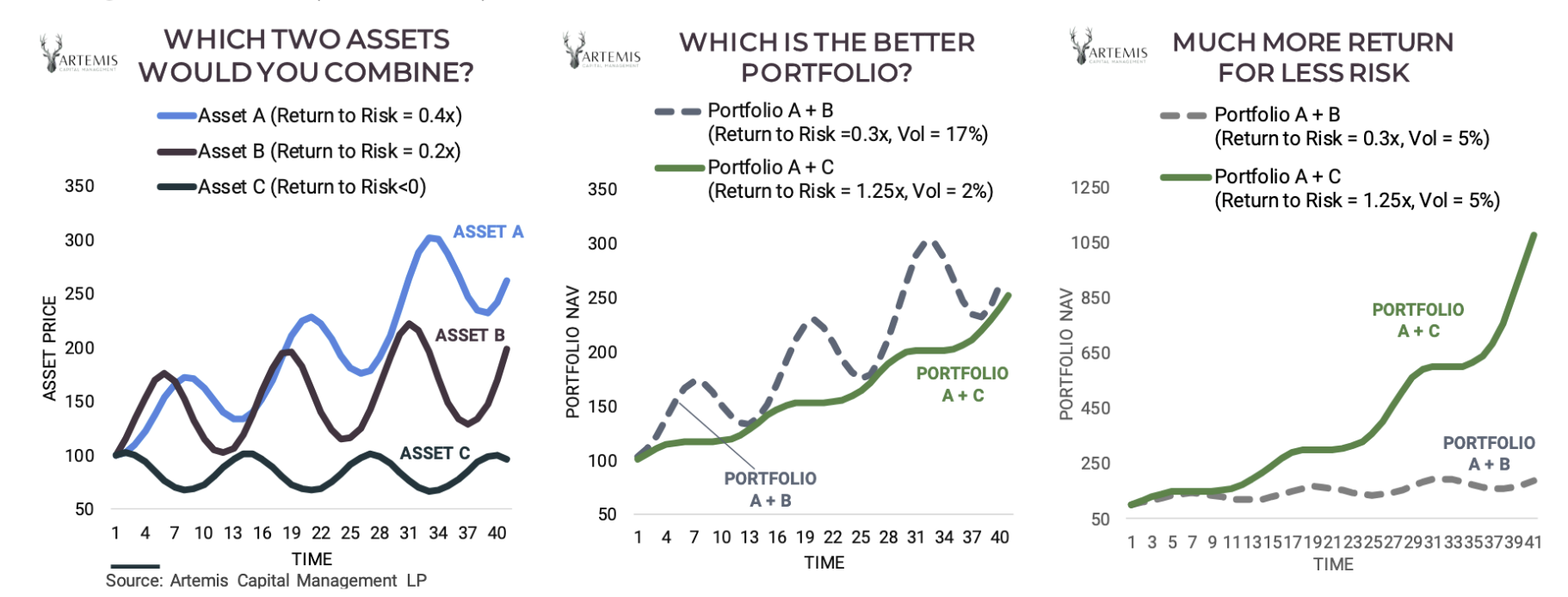
Why A + C beats A + B: Combining two assets that rise and fall on the same cycle (A + B — like owning ten domestic banks, developers, and consumer stocks together) keeps every violent drawdown intact (17% vol). Pairing A with an anti-correlated teammate C — like Shanghai Gold (518880.SH), Soybean Meal futures (159985.SZ), or sanction-antifragile tech — cancels out swings and turns the combined path into a smooth climb (2% vol).
为什么 A + C 完胜 A + B: 把两个同周期涨跌的资产凑在一起(A + B——就像同时买十只银行、地产与国内消费股),剧烈回撤丝毫不会减少(波动率 17%)。而把 A 与逆周期“队友”C 配对——如上海黄金(518880.SH)、豆粕期货(159985.SZ)或制裁反脆弱硬科技——波动相互抵消,整条净值曲线瞬间变得平滑(波动率降至 2%)。
Panel 3 rescales both portfolios to 5% volatility to compare risk-adjusted compounding; achieving equal volatility in practice may involve leverage and financing costs. 右图将两组合统一缩放至 5% 波动率以比较风险调整后复利;实盘等波动缩放可能涉及杠杆与成本。
Source · 来源: Artemis Capital Management LP · Open full size · 查看大图 ↗
Advanced: Structuring your picks into a 60 / 25 / 15 Barbell
进阶篇:把上述标的搭成一套 60 / 25 / 15 现代杠铃组合
If you simply want to replace idle 1.1% cash with a few policy- and market-aligned picks, the sections above already give you everything you need. For readers who want to take the next step — sizing those exact picks into a deliberate portfolio built to survive extreme macro shocks — finance offers a remarkably clean architecture: Nassim Taleb’s Barbell Strategy.
如果你只是想把闲置的 1.1% 存款换成几只顺应政策与市场的扎实资产,读完前四章其实已经足够上手。而如果你想更进一步——把上面那张标的清单按严格仓位比例组装成一套能扛住极端宏观风浪的系统——投资界有一套极其优雅的进阶结构:纳西姆·塔勒布的杠铃策略(Barbell Strategy)。
Standard finance pushes savers into the “moderate middle” — bank WMPs, opaque credit funds, or high-yielding bank stocks. Taleb showed why that middle is often the most fragile zone on earth: upside is capped at a few percent a year, while hidden left-tail risks (LGFV restructuring, financial repression, currency devaluation) lurk underneath. A Barbell abandons the fragile middle completely and organizes our onshore picks (beyond 6 months of living expenses) into three explicit roles:
传统理财总爱把人推向“中庸地带”——银行理财、下沉城投债基或貌似稳健的银行股。塔勒布一针见血地指出,这个中间地带往往是最脆弱的区域:向上收益被死死锁在每年几个点,向下却潜伏着城投重组、金融抑制与汇率贬值的尾部风险。杠铃结构彻底弃用脆弱中段,在留足 6 个月应急现金之外,把前文的具体标的精确划归三条腿:
- Heavy Left Wing — Policy-Aligned Physical Tollbooths (~60%): 600900.SH Yangtze Power (~30%), 510880.SH SSE Dividend ETF (~25%), and 600660.SH Fuyao Glass (~5%). Transparent, unlevered, cash-generating assets aligned with physical reality and the PBoC’s 1.0% relending floor.
- Uncorrelated Center Ballast (~25%): 518880.SH Huaan Gold ETF (~15%), 159985.SZ Soybean Meal Futures ETF (~5%), and 159980.SZ Non-Ferrous Futures ETF (~5%). Zero-premium macro shock absorbers that protect purchasing power if domestic growth, tariffs, or the currency takes a hit.
- Sized Right Wing — Antifragile Convexity & The Geopolitical Straddle (~15%): 601899.SH Zijin Mining (~6%), 002371.SZ NAURA Tech (~5%), 688041.SH Hygon Info (~2%; or 588000.SH), and 300308.SZ Zhongji Innolight (~2%). Pairing NAURA / Hygon (which gain when US chip blockades tighten — true antifragility) with Innolight (which wins on trade thaw and global AI capex) turns geopolitical headline risk into an onshore straddle.
- 厚实的左端——政策同向的物理收费站(约 60%):600900.SH 长江电力(约 30%)、510880.SH 红利 ETF(约 25%)与 600660.SH 福耀玻璃(约 5%)。透明、低杠杆、真金白银现金流,直接站上央行 1.0% 常设回购托底。
- 中段压舱石——零溢价、低相关宏观减震器(约 25%):518880.SH 华安黄金 ETF(约 15%)、159985.SZ 华夏豆粕 ETF(约 5%)与 159980.SZ 大成有色 ETF(约 5%)。当国内增长、关税或汇率承压时独立稳住购买力。
- 严控上限的右端——反脆弱凸性与地缘跨式结构(约 15%):601899.SH 紫金矿业(约 6%)、002371.SZ 北方华创(约 5%)、688041.SH 海光信息(约 2%,或 588000.SH)与 300308.SZ 中际旭创(约 2%)。把北方华创/海光(美国封锁越紧反而越强——真正的反脆弱)与中际旭创(受益于贸易缓和与全球 AI 扩张)配对,便在 A 股内部搭出了一副地缘政治跨式期权。
Compare this 60 / 25 / 15 barbell against the CSI 300 and 1.1% cash across five macro regimes below, alongside the 10-ticker starter blueprint, the expanded 21-company onshore peer bench (for splitting single-stock slots like the 30% Yangtze Power anchor), and the +20.3% QDII Premium Trap waterfall.
在下方一图对照这套 60 / 25 / 15 杠铃、沪深 300 与 1.1% 现金在五种极端宏观情景下的表现,以及 10 只入门核心标的、21 家同类扩展备选公司名录(便于拆分 30% 长江电力等单一仓位)与 +20.3% QDII 溢价陷阱的收益侵蚀拆解。
FIGURE 05 · ADVANCED: THE 60 / 25 / 15 ONSHORE BARBELL ACROSS FIVE REGIMES
Five-regime stress matrix, starter blueprint, expanded 21-company bench & the +20.3% QDII premium trap五种极端宏观情景一图对照、入门三柱清单、21 家扩展标的名录与 +20.3% QDII 溢价陷阱拆解
1. Five-Regime Stress Comparison (Illustrative 12-Month Real Return)
Low-CPI & Policy Floor低通胀 + 央行托底基准
10Y CGB stays ~1.6%, LPR frozen, PBoC 1.0% buybacks underpin high-dividend SOEs while global gold & AI hardware grind higher.10 年国债锚定 1.6%、LPR 按兵不动,央行 1.0% 回购托举高股息央国企,黄金与算力稳步走强。
40% Tariff & RMB Slide40% 关税冲击 + 汇率贬值
Broad equities and export optical names take a sharp hit, while Shanghai Gold (518880), Soybean Meal (159985), and domestic hydro/semi monopolies surge.大盘与出口算力承压,但沪金(汇率+避险双升)、豆粕(农业关税反制)与水电/国产替代强力对冲。
Severe Chip Sanctions半导体封锁全面升级
Washington tightens wafer-fab & GPU bans; global supply-chain tech wobbles while NAURA & Hygon capture forced state capex (true antifragility).美方全面收紧设备与算力管制,出海链震荡,但北方华创与海光信息承接刚性国产资本开支,展现反脆弱爆发。
Household Reflation (CGB > 2.8%)居民端强刺激(国债破 2.8%)
Direct household fiscal stimulus lifts CPI & CGB yields; bond-proxy utilities lag while non-ferrous metals, Zijin, and broad equities rally.居民直接财政刺激点燃再通胀,类债水电短暂跑输,但有色金属、紫金矿业与大盘顺周期同步拉升。
Surprise US–China Deal (RMB → 6.70)中美意外大妥协(人民币升至 6.70)
Tariffs drop and RMB surges; gold and soy-meal ballast pull back while global AI opticals (Innolight), Fuyao, and broad equities rip higher.关税大幅削减、人民币升值,沪金与豆粕压舱回吐,但中际旭创等出海算力与大盘风险偏好暴涨。
2. Pure-RMB Onshore Account Ticker Blueprint
纯境内 A 股账户三柱标的与门槛参考600900.SH30%China Yangtze Power 长江电力Gravity + electrons: six cascade dams on the Yangtze (~3.15% forward yield).重力与电流:长江六座梯级电站(远期股息约 3.15%)。
Main Board · ~¥3,100 / lot · 主板 · 约 ¥3,100 / 手510880.SH25%SSE Dividend ETF 红利 ETF~4.20% cash yield vs. 1.0% PBoC buyback relending rate (0% tax held >1 yr).约 4.20% 现金股息率 vs. 1.0% 央行回购再贷款基准(持股满 1 年免股息税)。
ETF · ~¥343 / lot · 场内 ETF · 约 ¥343 / 手600660.SH5%Fuyao Glass 福耀玻璃~35%+ global automotive glass share with onshore US manufacturing plants.全球汽车玻璃市占超 35%,且在美本土建厂。
Main Board · 100-sh lot · 主板 · 100 股/手
518880.SH15%Huaan Gold ETF 华安黄金 ETFTracks Shanghai Gold Exchange Au99.99 with ~0% NAV premium and T+0 liquidity.锚定上金所 Au99.99 现货黄金,T+0 交易且几乎零溢价。
T+0 ETF · ~¥747 / lot · ~0% premium · T+0 ETF · 约 ¥747 / 手 · 零溢价159985.SZ5%Soybean Meal Futures ETF 华夏豆粕 ETFNear-zero equity correlation; driven by South American weather and trade retaliation.与股市相关性近乎为零,由南美天气、展期收益与农业关税反制驱动。
T+0 Commodity ETF · ~¥210 / lot · 商品期货 ETF · 约 ¥210 / 手159980.SZ5%Non-Ferrous Futures ETF 大成有色 ETFSHFE physical basket (copper, aluminum, zinc, tin, nickel) at ~0% premium.上期所铜、铝、锌、锡、镍实物期货篮子,零溢价贴近现货。
T+0 Commodity ETF · ~¥210 / lot · 商品期货 ETF · 约 ¥210 / 手
601899.SH6%Zijin Mining 紫金矿业Bridge asset (~9.6x P/E, ~3.66% yield) with active A-share buybacks and global copper/gold.桥接型核心(约 9.6 倍 PE、3.66% 股息),兼具回购与美元计价铜金储量。
Main Board · ~¥2,485 / lot · 主板 · 约 ¥2,485 / 手002371.SZ5%NAURA Technology 北方华创Talebian antifragility to export controls: domestic semiconductor equipment leader.制裁反脆弱标的:国产刻蚀/沉积半导体设备龙头。
Main/SME 002 · ~¥35,000 / lot · 深市主板 · 约 ¥35,000 / 手688041.SH / 588000.SH2%Hygon Info (or STAR 50 ETF) 海光信息(或科创 50 ETF)Domestic x86 CPU + DCU accelerator monopoly; 588000.SH bypasses the ¥500k STAR gate.国产 x86 CPU 与 DCU 算力替代核心;科创 50 ETF 可无门槛小额参与。
STAR 688 (¥500k gate) · ETF ~¥124 / lot · 科创板 50 万门槛 · ETF 约 ¥124 / 手300308.SZ2%Zhongji Innolight 中际旭创Global AI optical transceiver chokepoint; high-beta USD revenue conduit.全球 AI 光模块供应链咽喉,高弹性美元资本开支传导通道。
ChiNext 300 (±20% limit) · high lot cost · 创业板 10 万门槛(±20% 涨跌幅)
3. Expanded Onshore Company Bench (Peer Substitutes & Deeper Diversification)
扩展 A 股标的名录:分散单一标的集中度,四大赛道 21 家备选龙头Diversifies the 30% Yangtze Power slot across coal-rail, offshore energy, telecom, nuclear, and expressways.分散长江电力单一标的重仓,横向铺开煤电运一体化、海上油气、电信、核电与高速收费站。
601088.SHMain Board · 沪市主板China Shenhua 中国神华Integrated coal, heavy-haul rail, ports, and power; flagship high-payout SOE directly aligned with Equity Dividend Finance.煤、路、港、电一体化闭环,高分红央企标杆,直接契合“股权财政”与央行回购托底。
600938.SHMain Board · 沪市主板CNOOC 中国海油Ultra-low-cost offshore oil & gas producer with high dividend payout and a built-in USD-energy geopolitical hedge.低成本海上油气巨头,高股息派发同时在纯人民币账户内嵌入美元油价与地缘对冲。
600941.SHMain Board · 沪市主板China Mobile 中国移动Nationwide connectivity monopoly sitting on massive net cash, rising payout ratios, and zero property/LGFV loan exposure.全国通信基础设施收费站,巨额净现金、分红率持续抬升,与地产及城投周期几乎脱钩。
003816.SZ / 600886.SHMain Board · 深/沪主板CGN Power / SDIC Power 中国广核 / 国投电力Regulated nuclear baseload (CGN) and Yalong River hydro (SDIC) — clean multi-decade power peers to Yangtze Power.核电基荷(中国广核)与雅砻江水电(国投电力),长江电力之外最干净的跨周期发电现金流。
600377.SH / 601006.SHMain Board · 沪市主板Jiangsu Expressway / Daqin Railway 宁沪高速 / 大秦铁路Literal physical transport tollbooths: Yangtze Delta highways and China’s core northern coal-rail artery.字面意义上的物理交通收费站:长三角核心高速路网与北煤南运重载铁路大动脉。
Broadens the Fuyao Glass sleeve with localized overseas factories, global grid capex, and high-FCF compounders.在福耀玻璃之外补齐海外本土建厂、全球电网设备与高自由现金流制造冠军。
000333.SZMain Board · 深市主板Midea Group 美的集团Global appliances, HVAC, and robotics (KUKA); ~40%+ overseas revenue paired with high ROE, dividends, and buybacks.全球家电、暖通与工业自动化(库卡)龙头,海外收入超四成,高 ROE 叠加分红回购。
600690.SHMain Board · 沪市主板Haier Smart Home 海尔智家Over half of revenue outside China with localized US/EU factories (GE Appliances, Candy) — tariff-insulated like Fuyao.海外收入过半,凭借 GE Appliances 等欧美本土工厂天然绕开高关税壁垒。
300750.SZ / 002594.SZChiNext 300 / Main · 创业板 / 主板CATL / BYD 宁德时代 / 比亚迪Global EV & battery champions expanding localized plants across Europe, Southeast Asia, and Latin America.全球动力电池与新能源车绝对龙头,加速在欧洲、东南亚与拉美本地建厂对冲贸易壁垒。
002028.SZ / 600406.SHMain Board · 深/沪主板Sieyuan Electric / NARI Tech 思源电气 / 国电南瑞Grid switchgear & transformers capturing both China’s UHV grid upgrades and the global AI data-center power bottleneck.输变电与电网二次设备龙头,同时受益于国内特高压投资与全球 AI 数据中心电网扩容周期。
300760.SZChiNext 300 · 创业板 10 万Mindray Medical 迈瑞医疗Global medical-device compounder (monitors, IVD, ultrasound) with ~40%+ overseas sales and disciplined cash payouts.全球医疗器械复利龙头(监护/IVD/超声),海外占比约四成,现金流与派息稳健。
Equity peers to Zijin Mining and the commodity ETFs for investors who want operational leverage to copper and gold.紫金矿业与商品期货 ETF 之外的硬资源股权标的,为铜金周期提供更高经营杠杆。
603993.SHMain Board · 沪市主板CMOC Group 洛阳钼业World-scale DRC copper & cobalt mines; pure USD-linked hard-asset leverage to global electrification and fiscal expansion.坐拥刚果(金)世界级铜钴矿,纯美元计价的全球电气化与再通胀硬资产弹性标的。
600547.SHMain Board · 沪市主板Shandong Gold 山东黄金Flagship onshore gold miner offering operational leverage above spot 518880.SH when gold enters a sustained bull run.境内黄金采掘龙头,在金价趋势上行阶段提供高于 518880.SH 现货 ETF 的经营杠杆。
Expands both sides of the right-wing straddle: domestic wafer/fab bottlenecks plus Main-Board-accessible AI hardware.同时加厚右端跨式两翼:一翼补强国产刻蚀与晶圆代工,另一翼纳入主板可直接买到的 AI 算力硬件。
688012.SHSTAR 688 · 科创板 50 万AMEC 中微公司Blockade leg: China’s premier dielectric etching toolmaker — direct technological complement to NAURA’s equipment suite.封锁反脆弱翼:国产介质刻蚀设备绝对龙头,与北方华创工艺矩阵形成高度互补。
688981.SHSTAR 688 · 科创板 50 万SMIC 中芯国际Blockade leg: flagship domestic foundry chokepoint (also a top holding inside 588000.SH for accounts below ¥500k).封锁反脆弱翼:国内先进制程晶圆代工总咽喉(不足 50 万门槛者可通过科创 50 ETF 间接持有)。
300502.SZChiNext 300 · 创业板 10 万Eoptolink 新易盛Global AI export leg: 800G/1.6T optical transceiver peer to Zhongji Innolight riding hyperscaler AI capex.出海算力翼:与中际旭创并驾齐驱的 800G/1.6T 光模块双雄,直连海外云巨头 AI 资本开支。
002463.SZ / 601138.SHMain Board · 深/沪主板WUS Printed Circuit / Foxconn Industrial Internet 沪电股份 / 工业富联Global AI export leg without ChiNext/STAR gates: high-layer AI server PCBs (WUS) and global AI server rack assembly (FII).无创业板/科创板门槛的出海算力通道:AI 高多层交换机 PCB(沪电)与全球 AI 服务器整机代工(工业富联)。
4. Why Never Pay a +20.3% QDII Secondary-Market Premium
算清一笔账:同样底层大涨 +12%,高溢价 QDII 如何反亏 −6%Even when the underlying index rises +12.0%, premium compression back to +1.0% turns a winning macro call into a −6.0% realized loss.即便标的指数如愿大涨 +12.0%,只要溢价回落至 +1.0%,最终到手仍是 −6.0% 净亏损。
Rule of thumb: avoid buying any QDII ETF above a ~1.5% premium. Capture global/USD exposure at 0% premium via Shanghai Gold (518880.SH) and onshore futures ETFs.实操铁律:溢价超 ~1.5% 的 QDII 一律不追;改用零溢价沪金、商品期货 ETF 与出海龙头实现外部敞口。
Advanced: What breaks each leg (when to change course)
进阶篇:每一条腿的证伪条件(什么时候该调仓)
No portfolio should ever be treated as permanent dogma. Before deploying capital — whether you hold two simple picks or the full three-pillar barbell — write down in advance the exact macro shifts that would falsify each leg:
永远不要把任何配置当成一成不变的教条。无论你只买了两三只核心标的,还是搭了完整的三柱杠铃,在投入第一块钱之前,都要提前写清每一条腿失效的宏观信号:
- Physical dividend floor breaks if China launches direct fiscal transfers to households, flipping food and housing CPI decisively positive and driving 10Y CGB yields past 2.5%–3.0%. Insurers will rotate violently out of bond-proxy utilities (600900) into beaten-down domestic consumer cyclicals.
- Gold & commodity ballast breaks if a surprise US–China grand bargain slashes tariffs and rallies the RMB sharply toward 6.70, compressing Shanghai gold’s currency cushion and soy-meal import spreads simultaneously.
- Antifragile tech leg breaks if Washington reverses chip/tool export bans in a trade deal (undercutting domestic substitution pricing power) or domestic fabs hit a physical lithography wall that stalls tool orders for four or more quarters.
- 物理红利底仓失效条件:中国转向大规模居民端直接财政补贴,食品与居住 CPI 实质性转正,推动 10 年期国债收益率突破 2.5%–3.0%。届时险资将剧烈抛售类债水电公用事业(600900),切换至超跌的内需消费顺周期。
- 黄金与商品压舱失效条件:中美意外达成全面关税大妥协,大幅削减关税壁垒并推动人民币汇率快速升值至 6.70 一线,沪金的汇率缓冲与豆粕进口价差会同步回吐。
- 反脆弱硬科技失效条件:美国在贸易协议中大幅放开先进芯片与晶圆设备对华许可(瞬间瓦解国产替代溢价),或者国内晶圆厂撞上物理光刻瓶颈,导致下游设备订单连续四个季度停滞。
Good investing is not predicting next quarter’s headlines — it is knowing what each asset is hired to do, and what macro signal tells you its job is over.好的投资不是去猜下个季度的新闻头条,而是清楚知道每份资产被雇来干什么活,以及出现什么宏观信号说明它的任务结束了。Review the three-tier safety ladder and the complete regime falsification atlas below.
在下方速查图谱中逐一核对三层安全观与四项策略证伪开关。
Field guide: Three levels of safety & what overturns each leg实战速查:三层安全观与每条腿的证伪开关
Safety ladder 三层安全观
Level 1 · Nominal Illusion 第一层 · 名义幻觉
“Stocks swing 10% a day; my 1.1% bank deposit or R2 WMP never loses principal, so cash is safe.”
“股市一天能跌 10%,我的 1.1% 定期存款和 R2 理财不亏本金,所以拿现金最安全。”
Confuses smooth accounting lines with purchasing-power survival under financial repression.
把账面净值不波动误当成真实安全,在金融抑制下默默承担购买力与汇率侵蚀。
Level 2 · Yield-Trap Safety 第二层 · 伪稳健陷阱
“Buy A-share Big-4 banks for 4.5% dividends, luxury baijiu for 90% margins, or Nasdaq QDII ETFs at +20% premium.”
“买 A 股四大行吃股息、买高端白酒图高毛利,或者顶着 20% 溢价追买纳指 QDII。”
Banks carry opaque LGFV/property command risk; luxury spirits track shrinking property wealth; +20% QDII premiums destroy expected value on day one.
国有行背负隐性城投/地产让利黑箱;高端白酒受地产财富效应拖累;高溢价 QDII 一买入就先亏 17% 净值。
Level 3 · Structural Barbell 第三层 · 结构化杠铃
“Pair transparent physical monopolies backed by the 1.0% PBoC buyback floor with zero-premium gold/commodity ballast and sanction-antifragile tech.”
“用央行 1.0% 回购托底的物理垄断现金流打底,叠加零溢价黄金/商品期货压舱,再配一笔受益于封锁与波动的硬科技期权。”
Requires discipline: you must accept daily price noise, hold >1 year for 0% dividend tax, and monitor regime-flip triggers.
代价是必须忍受日常波动、坚持持股满一年享受 0% 股息税,并持续盯紧宏观证伪信号。
Falsification atlas 证伪图谱
Left Barbell · Physical Tollbooths (60%) 左端杠铃 · 物理收费站(60%)
Thesis 核心假设
10Y CGB stays pinned (~1.6%) while Beijing shifts from Land Finance to Equity Dividend Finance via the permanent 1.0% buyback facility.
10 年国债锚定低位(约 1.6%),政策借 1.0% 常设回购再贷款推动“土地财政”转向“股权财政”。
Breaks When 证伪触发条件
Genuine household reflation + direct fiscal transfers push food/housing CPI firmly positive and lift 10Y CGB yields past 2.5%–3.0%.
居民端直接财政刺激启动,食品与居住 CPI 转正,10 年期国债收益率突破 2.5%–3.0%。
Action 应对动作
Insurers dump bond-proxy utilities (600900) for beaten-down consumer cyclicals — rotate part of the left wing into domestic demand beta.
险资将抛售类债水电公用事业转向消费顺周期——此时应把部分左端仓位切换至内需弹性。
Center Ballast · Gold & Commodity Futures (25%) 中段压舱 · 零溢价黄金与商品期货(25%)
Thesis 核心假设
Tariff friction, global fiscal deficits, and RMB depreciation pressure keep gold, soy meal, and industrial metals uncorrelated with A-share drawdowns.
关税摩擦、全球财政赤字与汇率承压,使黄金、豆粕与有色期货成为 A 股下跌时的独立减震器。
Breaks When 证伪触发条件
A surprise US–China grand bargain slashes tariffs and triggers rapid RMB appreciation toward 6.70.
中美意外达成全面贸易大妥协、大幅削减关税并推动人民币快速升值至 6.70 一线。
Action 应对动作
Shanghai gold’s RMB cushion and soy-meal import spreads compress simultaneously — rebalance ballast back to target weights rather than chasing.
沪金汇率缓冲与豆粕进口价差同步回撤——按纪律再平衡,勿在情绪顶点追高。
Right Barbell · Antifragile Tech & Resources (15%) 右端杠铃 · 反脆弱硬科技与资源(15%)
Thesis 核心假设
Pairing domestic substitution (NAURA/Hygon) with global AI/copper winners (Innolight/Zijin) turns geopolitical uncertainty into a convex straddle.
以国产替代(北方华创/海光)搭配全球算力与铜金(中际旭创/紫金),把地缘不确定性化为凸性跨式结构。
Breaks When 证伪触发条件
Washington licenses advanced US wafer tools/GPUs back into China (undercutting domestic substitution) OR domestic fabs hit a lithography wall stalling orders for 4+ quarters.
美国放开高端芯片/设备对华许可(瓦解国产替代定价权),或国内晶圆厂遭遇光刻瓶颈导致设备订单连续停滞 4 个季度以上。
Action 应对动作
Keep single high-vol legs strictly capped at 15% total; rebalance windfalls back into the cash-flowing left wing.
严守右端总仓位上限(约 15%),剧烈脉冲暴涨后将超额收益收割回左端物理现金流。
Onshore Discipline · QDII Premium & Tax Rules A 股实操纪律 · QDII 溢价与股息税边界
Thesis 核心假设
Onshore A-shares held >1 year enjoy 0% dividend tax, while SAFE quota caps can blow out QDII ETF premiums past +15%–20%.
A 股持股超 1 年享 0% 股息个税,而外管局额度受限时跨境 QDII 场内溢价常飙至 15%–20% 以上。
Breaks When 证伪触发条件
SAFE sharply expands QDII quotas so secondary-market premiums on Nasdaq/S&P QDII ETFs collapse below 1.0%–1.5%.
外管局大幅扩容 QDII 额度,纳指/标普跨境 ETF 二级市场溢价回落至 1.0%–1.5% 以内。
Action 应对动作
Only when QDII premiums normalize near NAV does direct onshore US-index allocation become positive-EV again; otherwise stick to 0%-premium local conduits.
唯有溢价回归净值附近,场内跨境宽基才重新具备正期望;高溢价期坚决使用零溢价黄金、商品与出海龙头替代。
The one-sentence mental model
一句话心智模型
Strip away the bank pamphlets, the macro jargon, and the ticker noise, and an onshore A-share investor’s entire survival manual fits into one sentence:
剥去银行宣传单、宏观黑话与代码噪音,仅用 A 股账户生存的底层心法可以浓缩成一句话:
Because banks create M2 out of thin air against property and infrastructure loans — and then pin rates near zero to keep those loans alive — true onshore safety comes not from “steady” bank yields, but from owning policy-backed physical cash flows, zero-premium global/commodity shields, and capped growth engines that do not all break on the same day.因为银行对着地产与基建贷款凭空创造了 M2,又不得不把利率死死按在地板上为这些债务续命,所以真正的境内安全从来不在“看似平稳”的银行理财里,而在于直接持有政策托底的物理现金流、零溢价的黄金与商品护盾,以及不会在同一个周二集体熄火的成长引擎。Keep four operational anchors whenever you review your RMB account:
每次打开人民币证券账户时,记住这四条锚点:
- Always look at the other side of the ledger. Every “safe” deposit or WMP is backed by real-economy credit; if the yield sits near 1%–2%, you are paying the silent tax of financial repression.
- Start with aligned picks, then diversify by engine. You do not need a finance degree: a hydro monopoly, a broad dividend ETF, a zero-premium gold ETF, and a global winner already beat ten correlated domestic stocks on almost every stress test.
- Respect onshore market plumbing. Hold dividend A-shares past 1 year for the 0% tax edge, never pay a +20% secondary-market premium for quota-starved QDII ETFs, and use low-lot ETFs when board gates are too steep.
- Watch the triggers, not the noise. Keep your eye on three dials — the 10Y CGB yield (~1.59%), food/housing CPI, and US–China tariff/sanction policy — and rebalance calmly when any leg runs far past its target weight.
- 永远看账本的另一头。 每一份“稳健”存款与理财背后都是实体信用;当收益率被压在 1%–2% 时,你正在默默缴纳金融抑制税。
- 先选对同向标的,再按不同引擎分散。 不需要经济学学位:一座水电站、一只红利 ETF、一份零溢价黄金再加一家出海龙头,在几乎所有宏观压力测试里都完胜十只同涨同跌的国内个股。
- 尊重 A 股本土管道规则。 拿满一年吃透 0% 股息税红利,坚决拒绝 +20% 溢价的额度稀缺型 QDII,善用低门槛 ETF 绕开高额板块门槛。
- 盯紧开关,忽略噪音。 只需要盯住三块仪表盘——10 年期国债收益率(~1.59%)、食品与居住 CPI、以及中美关税与科技管制走向——并在某一端涨过头时冷静再平衡。
Note: This essay is an educational synthesis of monetary mechanics, portfolio theory, and late-2026 China macro research for onshore A-share investors — not individualized financial advice. Markets, yields, tax rules, and ETF premiums move constantly; verify current prices, NAV premiums, and personal risk tolerance before making any allocation.
说明:本文是对货币创造机制、现代投资组合理论与 2026 年末中国宏观研究的中英双语知识梳理,仅作教育与框架探讨,不构成针对个人的投资建议。市场价格、股息率、税制与 ETF 溢价率随时变化,实际配置前请务必核实最新数据并评估自身风险承受能力。